





Imagine you’re on a fast-moving AMM launch: gas spikes, slippage windows close in seconds, and a token approval dialog pops up that you have to sign immediately if you want exposure. For a DeFi power user in the US who regularly juggles trades across Layer 2s and multiple chains, that scenario isn’t hypothetical — it’s the daily calculus. The difference between a profitable slice of yield and a drained wallet is often not the code under the hood but the information you see before you hit “Confirm.” That’s where Rabby’s pre-transaction simulation and risk scanning become a decision lever rather than a nice-to-have.
This article walks through how to download and install Rabby, why its transaction-simulation mechanism changes the signing game, how it compares with common alternatives, and what you should watch for — limits, trade-offs, and operational hygiene that matter for high-stakes DeFi use.
Step‑by‑step: Downloading and Installing Rabby
Rabby is available as a Chromium-based browser extension, desktop client (Windows/macOS), and mobile app (iOS/Android). For a browser-based workflow — the most common choice for power users who use many dApps — you install it like any other extension. If you prefer to begin at the project page and verify sources before installing, you can learn more about the wallet at this official resource: rabby wallet.
High-level install checklist for a secure start:
- Download the extension from the official store for Chrome, Brave, or Edge, or get the desktop app from the project’s releases page (verify signatures where provided).
- Decide: create a new non-custodial wallet or import an existing seed/private key. If you import, consider migrating small test funds first to confirm address and integrations.
- Enable hardware wallet integration right away if you use a Ledger, Trezor, or another supported device — this converts a locally stored seed into a signer that never exposes private keys to the extension.
- Familiarize yourself with the Flip toggle if you run multiple wallets (Rabby vs. MetaMask) to control which extension becomes the browser default.
Installation is straightforward; the nontrivial work is config and habit: enabling hardware wallets, whitelisting dApps you trust, and using the approval-revocation tool to clean up granted allowances.
How Rabby’s Transaction Simulation Works — Mechanism, Not Magic
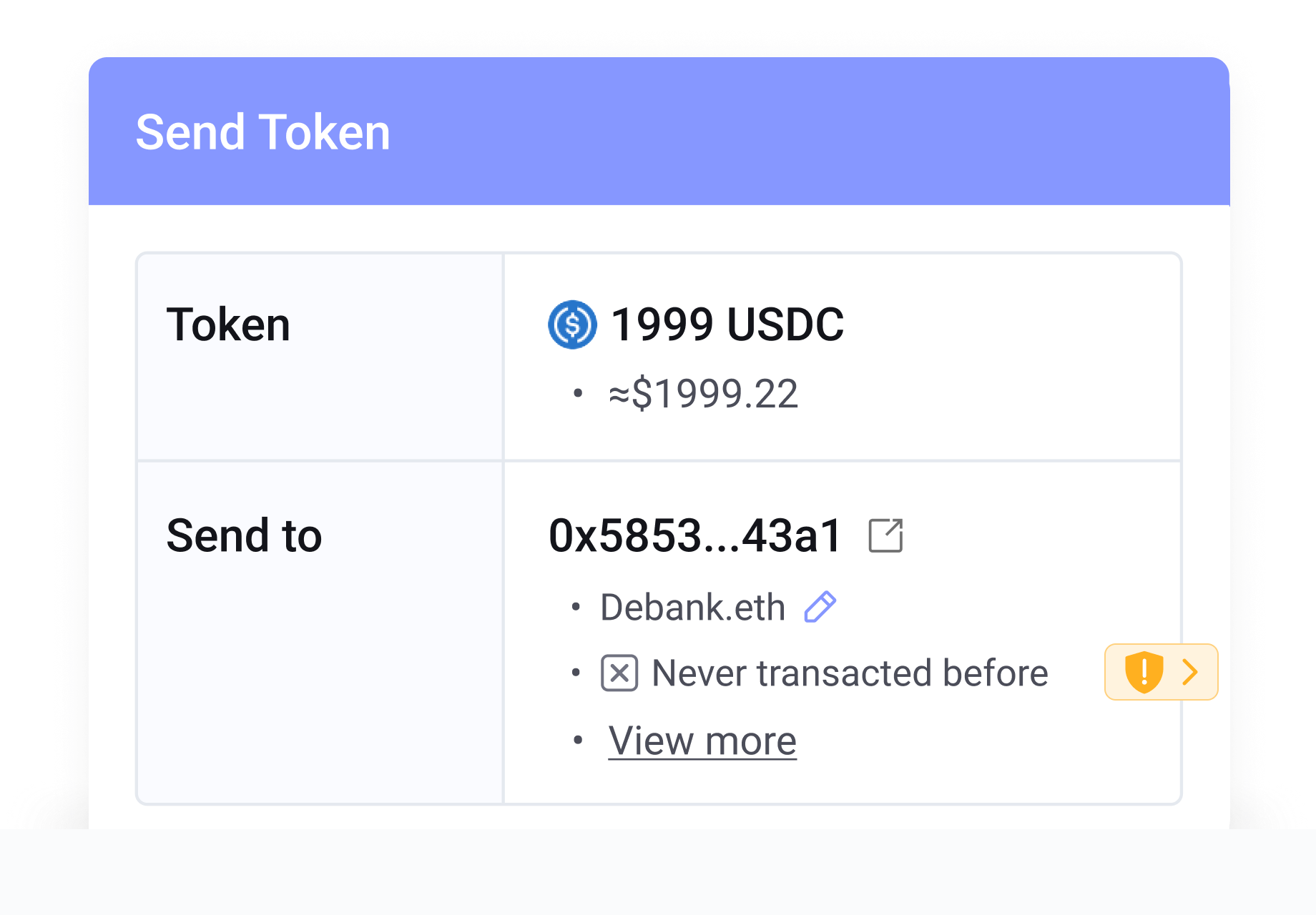
At its core, Rabby’s transaction simulation is an off‑chain replay of what a signed transaction would do, using the same inputs the dApp will send to the network. Mechanistically, the wallet constructs the transaction payload and asks a local or remote node to execute it against the chain state in read-only mode. The simulation produces an estimated delta: exact token balance changes, gas cost estimates, swapped amounts, and whether an approval or transfer would fail or succeed under current conditions.
Why this matters: blind signing — where users approve a transaction without seeing the concrete outcome — is one of the primary vectors for accidental loss. A simulation converts an abstract approval or send request into a forecasted outcome. It answers practical questions: Will this approval grant infinite allowance? Is this transfer sending tokens to a contract address that previously had known exploits? How much will my wallet actually lose in fees if gas spikes before propagation?
Rabby pairs simulation with a pre-transaction risk scanner that flags suspicious contracts, previously exploited addresses, and unusual allowance requests. Together, these systems create an evidence surface that supports decisions: sign, modify (e.g., change slippage or gas limit), or reject.
What Simulation Catches — and What It Doesn’t
Simulation is excellent for deterministic outcomes: contract logic under current chain state, arithmetic errors, and immediate balance deltas. It catches many forms of failure and clarifies expected token flows, which is why Rabby displays exact estimated token balance changes alongside fee costs before you sign.
Limitations remain. Simulation cannot predict off-chain actions a contract’s backend might execute (for example, an external oracle update that triggers an unexpected on-chain reaction after your transaction finalizes). It also cannot prevent front-running or sandwich attacks; simulation shows what your specific transaction will do, but not how other actors will react in the mempool. Finally, simulations are accurate only under the current state snapshot — reorgs, race conditions from competing transactions, or gas price volatility can change the real outcome between simulation and inclusion.
Comparative Trade-Offs: Rabby vs. MetaMask and Others
Rabby is clearly positioned for security-minded DeFi users who want multi-chain coverage and decision-grade pre-signing information. Below are the practical trade-offs compared with common alternatives.
What Rabby gives you that many wallets don’t: explicit transaction simulation, automatic network switching when a dApp requires a specific chain, built-in approval revocation, and a dashboard that aggregates positions across 90+ EVM-compatible chains. These features reduce operational friction and make it easier to spot dangerous approvals or phantom transfers.
What you might trade away: Rabby does not include a native fiat on-ramp, so for U.S. users who prefer buying crypto in-wallet with a debit card, a separate on-ramp service or exchange is necessary. Rabby also lacks native staking tools — if you want a wallet that lets you buy, stake, and manage fiat purchases in a single place, you’ll combine Rabby with other services.
Security posture: Rabby is open-source under MIT, supports hardware wallets, and integrates with institutional tools like Gnosis Safe and Fireblocks. That lowers systemic trust risk. But remember: an open-source codebase and prior incident mitigation (the 2022 Rabby Swap exploit and subsequent compensation/audit improvements) reduce but do not eliminate risk. The right setup for a DeFi pro often pairs Rabby’s simulation with hardware signing and a minimal set of high-privilege approvals.
Practical Workflows and Heuristics for Power Users
Here are decision-useful heuristics you can adopt immediately.
- Always simulate large or unusual transactions: if a trade, liquidity provision, or contract interaction exceeds your typical ticket size, run the simulation and examine the balance delta line-by-line.
- Use the approval revocation tool after interacting with ephemeral DEXes and aggregators. Prefer explicit single-amount approvals where possible rather than infinite allowances.
- Combine simulation with hardware wallets for high-value operations. Simulation gives you the expected outcome; the hardware device keeps your keys offline until signing.
- For cross-chain activity, use Rabby’s gas top-up to avoid stuck transactions on chains where you lack native gas — but be mindful of bridging risks and fees when moving assets to acquire gas tokens.
- Treat simulation output as a snapshot: under high congestion, re-simulate if you wait more than a few minutes to sign.
These practices narrow the attack surface from both human error and composability complexity that defines modern DeFi.
Where Rabby Breaks Down — Boundary Conditions and Risks
Important boundary conditions to accept upfront:
1) Simulation is only as good as the node and chain state used — if your node lags or the mempool changes materially, simulation can diverge from reality. 2) Simulations do not protect against behavioral exploits like social-engineering or signing messages outside normal transactions. 3) Institutional setups that use multi-sig or custodial vaults still face policy-level risks (e.g., governance, private key procedures) that wallet simulation can’t fix.
Another trade-off: automatic network switching removes friction but can mask intent if you’re not paying attention. A wallet that auto-switches to Arbitrum for a particular dApp is convenient, but it’s also a rational place for a user to lose track of which assets are on which chain. Good operational discipline: check the network badge and the simulated balance delta before signing across chains.
Near‑Term Signals to Watch
For U.S.-based DeFi professionals, a few signal types will matter in the months ahead:
- Regulatory and compliance signals around wallet-to-exchange flows: if on‑ramp providers tighten AML/KYC for certain flows, Rabby’s lack of a native fiat ramp could become a gating factor for new users but less so for power users who already use exchanges.
- Improvements to mempool transparency and MEV mitigation could change how useful transaction simulation is for front-run protection; simulation will still report outcomes for your transaction, but fewer front-running opportunities would reduce the difference between simulated and executed outcomes.
- Expanding hardware support and institutional integrations will keep Rabby attractive to teams that need multi-sig workflows; watch how integrations with custodial services evolve for institutional adoption.
These are conditional scenarios: each depends on external policy, market, and technical developments rather than being guaranteed trajectories.
FAQ
Does Rabby’s transaction simulation guarantee safety?
No. Simulation significantly reduces uncertainty by showing likely token deltas and fee costs under current chain state and helps catch common pitfalls such as erroneous approvals or contract failures. However, it does not eliminate risks from off-chain triggers, mempool race conditions, or human errors like signing unexpected messages. Treat simulation as an informed checkpoint, not an absolute guarantee.
Can I use Rabby with my Ledger or Trezor?
Yes. Rabby supports major hardware wallets (Ledger, Trezor, Keystone, and others). Pairing simulation with a hardware signer is a strong operational posture: simulation tells you what will happen; the hardware wallet ensures your private key never touches the extension.
How does Rabby compare to MetaMask for active traders?
Rabby’s strengths are transaction simulation, automatic network switching, built-in approval revocation, and multi-chain aggregation across 90+ EVM networks. MetaMask has broader name recognition and some ecosystem integrations, but lacks a native pre-sign simulation layer of the same depth. For active traders who value pre-sign information and multi-chain visibility, Rabby provides decision advantages; the trade-offs are the absence of an in-wallet fiat on-ramp and no native staking interface.
What should I do after installing Rabby for the first time?
Verify the extension source, create or import your wallet, connect a hardware device if you use one, and run a low-value test transaction on each primary chain you use. Familiarize yourself with the approval-revocation interface and turn on automatic network switching if you want the convenience — but also train yourself to read and confirm the simulated deltas before signing.
Bottom line: for DeFi power users the value of a wallet is less about brand and more about the decision environment it creates. Rabby’s transaction simulation converts ambiguous signing prompts into concrete forecasts; combined with revocation tools and hardware integration, that changes the arithmetic of trust. But simulation is a tool with boundaries. Use it deliberately, pair it with hardware signing and allowance hygiene, and treat the output as a strong signal — not a substitute for operational discipline.